
-BY KENT MCLEMORE
Generator load testing has always been part of doing the job right. What changed is how the rules now stack up.
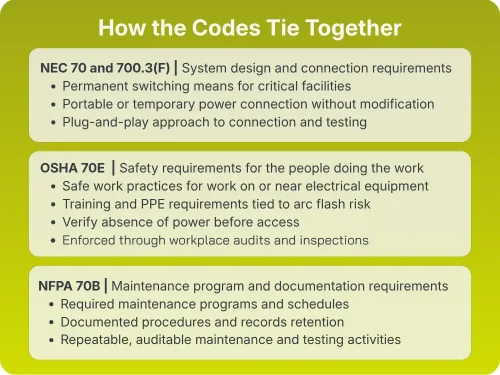
Requirements from the National Fire Protection Association (NFPA), the Occupational Safety and Health Administration (OSHA), and the National Electrical Code (NEC) are now more closely aligned, with no loopholes and clearer liability. That puts common field routines under a brighter spotlight, especially when testing requires removing dead fronts, loosening lugs, or disconnecting permanent wiring.
This article breaks down why those past practices are no longer code-compliant and what generator load testing looks like now, including how we approach it at Power Temp Systems.
Key takeaways:
- Generator compliance now ties together NFPA 70B, OSHA 70E, and NEC 70 and 700.4(F), which raises accountability for how load testing is performed.
- Many common practices that involve removing dead fronts, loosening lugs, or disconnecting permanent wiring create arc flash risk and degrade equipment.
- Safer, repeatable connection methods are now mandated, making it no longer acceptable to alter the system for testing or generator maintenance.
- Compliance increasingly expects verification steps, documented procedures, and maintenance records that can be reviewed and audited.
- Code-compliant testing is moving toward plug-and-play connections, voltage verification before access, and thermal readings under load to catch problems early.
Why Legacy Load Testing Practices Fail
Many unsafe, incorrect methods to load bank generators began because the existing system was not designed with a way to plug in a load bank. That gap led to unwiring and altering permanent connections, repeated over time, which degrades the system.
The issue is that all past practices were not code-compliant, but the codes were vague and not mandated. These practices also created dangerous situations in addition to degrading the system. That is why safety expectations from OSHA 70E and the maintenance requirements formalized in NFPA 70B now matter in a very critical way during routine testing.
Here are three legacy practices that keep showing up in the field, and why each one fails in real life.
1. Opening Enclosures and Removing Dead Fronts to Access Breaker Lugs
This usually happens when techs need to test voltages or make connections.
OSHA 70E applies immediately in this scenario. Working in live electrical gear to test voltages is not safe and requires full arc-flash personal protective equipment (PPE). Once the cover is off, the system is also exposed to the elements.
In real-world conditions, that increases risk for technicians. It also increases the likelihood of issues that turn a routine test into a failure event.
2. Disconnecting and Reconnecting Permanent Wiring for Load Banking or Temporary Tie-ins
This shows up as permanent wiring being disconnected, cables run through buildings, and temporary wiring routed into switchgear, with all safety barriers removed and existing connections altered and degraded.
Under NEC 70, the expectation is straightforward. The equipment was installed as a permanent electrical system, and routine testing is no longer expected to require disconnecting and reconnecting permanent wiring just to tie in a load bank or portable generator. In critical facility settings, NEC 700.4(F) makes the “no modification required” expectation explicit.
It might work in the moment, but it forces the system to be altered every time you test. That turns generator maintenance into repeat disassembly and reassembly. Over time, that is how systems get degraded, which is exactly what NFPA 70B is trying to prevent through repeatable, documented maintenance procedures.
3. Using Connection Points Not Designed for Repetitive Connection Cycles
This is where many failures show up.
Techs loosen and re-tighten breaker lugs and push fine-strand portable power cable into lugs designed for THHN, torqued to specification, marked, and left alone. Those lugs are not designed for repetitive use, and you cannot always be set back to the manufacturer’s recommended torque specs.
Over time, poor terminations create resistance and heat. Electricity follows the path of least resistance, and damaged connection points become failure points. This is why burned lugs and overheating show up so often after repeated testing, and why thermal inspections are now part of the maintenance expectation.
What Generator Load Testing Should Look Like Now
Code-compliant testing is now expected to be safe, repeatable, and non-damaging. The goal is to test the generator and its main output breaker under load without altering the system, exposing live parts, or creating new failure points in the process.
Code Requirement: Test Without Altering the System
This requirement is driven by NEC 70 expectations for how electrical systems are installed and connected, and reinforced by NFPA 70B maintenance procedures that do not rely on any disassembly or alteration of the existing system.
Load bank testing and temporary power connections should be plug-and-play. No pulling covers, loosening lugs, or disconnecting and reconnecting permanent wiring.
If a test requires disassembly, it is a sign that the system is not set up for compliant operation and testing.
Code Requirement: Verify Absence of Power Before Access
This requirement is most directly tied to OSHA 70E safe work practices, training, and PPE expectations when working on or near electrical equipment.
Before anyone goes into equipment or makes connections, verify absence of power. Voltage test ports support this job flow by allowing verification from outside the enclosure before access.
Confirm safe conditions first, then proceed with the right PPE and trained personnel.
Code Requirement: Thermal Imaging and Documented Results
This requirement is formalized through NFPA 70B, which makes generator or backup power maintenance programs, documentation, and repeatable procedures part of the expectation.
Thermal imaging becomes part of the test. Use infrared (IR) windows, IR guns, or thermal sensors to capture readings under full load of the generator main output breaker and connections, then document and log results as part of the maintenance record. Separate load bank breakers are not allowed because the test must be performed on the main output breaker.
The point is practical. Heat at terminations is an early warning sign of system degradation, and logging makes the work repeatable and defensible.
Build Generator Compliance Into Every Load Test
The industry has moved from field-expedient workarounds to testing that is safe by design. With NEC 70 and 700.3(F), NFPA 70B, and OSHA 70E now more specifically aligned and referenced, generator load testing is expected to be repeatable, documented, and performed without altering the system.
That is what we support at Power Temp Systems. We provide code-aligned, spec-grade power distribution solutions that enable testing and temporary power connections without exposed access to live parts or damage to permanent connections.
Our core offerings include:
If you are upgrading an existing site or designing a new one, build compliant testing capabilities into the electrical system from the start. With these code changes now tied directly to OSHA, there are no loopholes or grandfathering existing systems. Explore our code-compliant connection and testing solutions for your next project.