
A typical project tends to separate power system design from long-term maintenance. Design teams deliver the correct solution to be installed. Operations teams keep it running.
In the past, there was a disconnect between what engineers knew and what operations did for maintenance and testing. That disconnect shaped how generators and electrical gear were tested and serviced in real-world conditions. However, updated standards have deemed this approach detrimental and unsafe, removing any gray areas.
Requirements tied to the National Fire Protection Association (NFPA), the Occupational Safety and Health Administration (OSHA), and the National Electrical Code (NEC) are now more closely aligned, leaving no loopholes when routine work depends on open-gear access or field modification. This article explains what that shift means for engineers and emergency power system design.
Key takeaways:
- NEC requirements, including 700.3(F), make testing and temporary power tie-ins part of the mandatory design scope.
- NFPA 70B pushes maintenance into a defined process with specified intervals, procedures, and records, depending on mandated evaluations by certified companies.
- NFPA 70E and OSHA make open-gear verification and field modification a safety and liability issue.
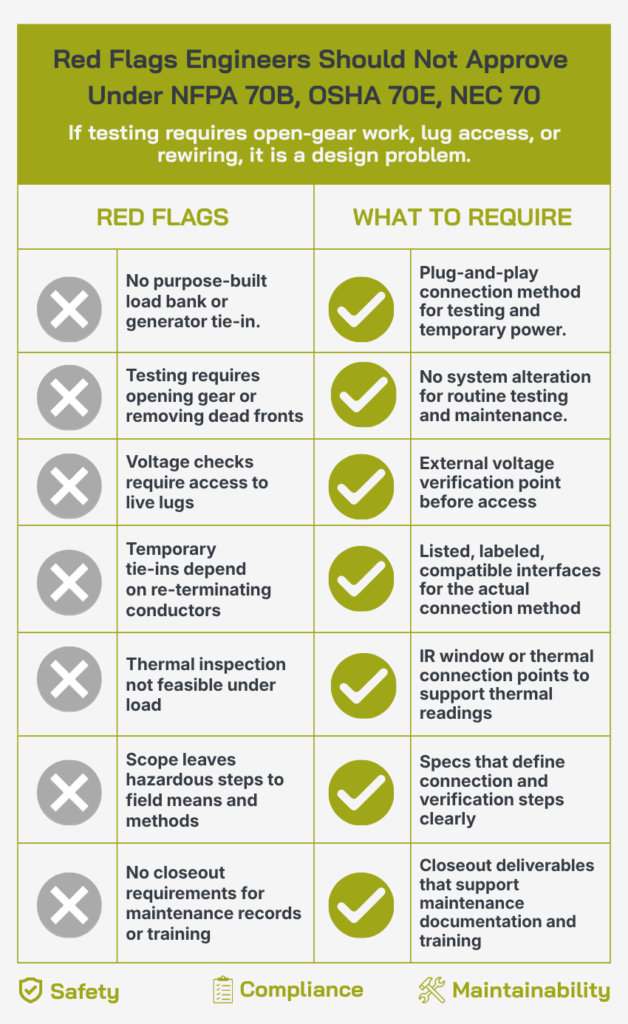
- Red flags that design engineers should catch in specs and submittals that force unsafe access or altering of the permanent system wiring.
- How engineers can reduce risk by designing plug-and-play testing and safe verification workflows from the start.
- Where Power Temp Systems solutions fit to support compliant connections, verification, and thermal access without altering the system.
Shift 1: NEC Requirements Made Testing and Temporary Power a Design Decision
The first code compliance shift is that testing is now part of the design mandate. The National Electrical Code has always set the installation baseline. NEC 700.3(F), added in the 2017 NEC for critical facilities, makes the tie-in expectation explicit and prohibits modification of the connection method.
Under 700.3(F), facilities deemed critical need a defined, permanent means to connect temporary generation and load testing equipment without altering the electrical system. All non-critical facilities at a minimum must have a way to load test the permanent system without altering any wiring or connections.
If the workflow requires opening gear, removing dead fronts, loosening lugs, or disconnecting permanent conductors, the project is relying on a workaround that the code environment no longer allows. That drives unsafe access, degrades the systems, and increases risk for owners and project teams.
Engineers encounter this shift in two places. First, in design decisions that determine whether testing and maintenance can be performed without disassembly. Second, in submittal reviews where it becomes clear that the only workable method relies on open gear access or field modification.
Design Implications for Engineers:
Treat how it will be tested as a design requirement.
If a generator can only be load tested by removing covers and accessing breaker lugs, the project is effectively designed around a workflow that the code environment no longer allows.
Do not assume field teams can legally make it work.
If the only path requires opening enclosures, removing dead fronts, and leaving gear exposed to weather or anyone else during service, the risk is baked into the design, not created by contractor means and methods.
Flagging noncompliant tie-in approaches should be during design and time of specification.
If the design spec implies temporary leads routed into gear, repeated lug work, or any modification of permanent connections to perform routine testing, treat it as a compliance and design issue that must be corrected before it becomes the field solution. All SMEs from design through installation are liable to red flag any and all non-code-compliant issues.
Shift 2: NFPA 70B Turned Maintenance Into a Defined Program With Records
Another key milestone for engineers to understand is that NFPA 70B is no longer framed as an optional good practice. In January 2023, it moved from a recommended practice to a full standard, which is why maintenance programs, intervals, and documentation are now being treated as mandated requirements instead of suggestions.
The takeaway is that generator maintenance is now expected to operate with defined procedures, repeatable workflows, and records that hold up under review. That puts pressure on design and specs, because the equipment layout and connection methods either make compliant maintenance achievable or force one-off work that is difficult to perform safely and difficult to document, and is not code compliant.
This matters to engineers because maintenance frequency and priorities are driven by equipment condition and context, including criticality, operating environment, age, and condition of equipment. Some facilities will require more frequent verification and inspection by design, which increases the cost of any workflow that depends on disassembly.
Design Implications for Engineers:
Design for repeatable maintenance without disassembly.
If maintenance depends on disconnecting and reconnecting permanent wiring, the system will be altered every time it is serviced, which drives degradation and creates documentation problems.
Assume maintenance frequency will vary by condition and environment.
Critical facilities and harsh environments raise the burden of proof. Designs should include practical access to verify, inspect, and test without opening gear.
Make documentation achievable in the real workflow.
The easier it is to perform testing and verification through purpose-built connection and access methods, the easier it is to keep accurate records and defend the maintenance program.
Shift 3: NFPA 70E and OSHA Made Unsafe Access a Safety and Liability Issue
NFPA 70E is the standard for electrical safety in the workplace, and many organizations use it as the practical framework for meeting OSHA electrical safety expectations, including OSHA 1910 Subpart S and OSHA 1926 Subpart K.
Recent 2024 revisions to the NFPA 70E standard enforce a more proactive approach focused on hazard identification, risk assessment, and applying controls to establish electrically safe work conditions. The practical consequence is clear. Routine workflows that require opening equipment to verify voltage at lugs or making connections on potentially energized parts are no longer acceptable as normal service steps.
This matters because NFPA 70E does not stay contained to internal safety manuals. If violations are found through inspection or incident reporting, OSHA may issue citations that reference NFPA 70E. The standard also recognizes that other governmental entities and insurers may use it when evaluating electrical safety, coverage, and liability.
Design Implications for Engineers:
Make safe verification possible before enclosure access.
Provide a defined way to verify absence of power without opening gear or reaching lugs.
Design out routine energized exposure.
If standard testing or service assumes covers come off and terminations get touched, the design is forcing a noncompliant workflow.
Expect consequences beyond the jobsite.
Designs that rely on open-gear steps tend to surface during inspections, incidents, and insurance review, not just during maintenance.
Build Code Compliance Into the Design, Not a Workaround
For engineers, the takeaway is clear. NEC 700.3(F), NFPA 70B, NFPA 70E, and OSHA are now intertwined and stacked together, making testing and maintenance workflows part of design accountability.
If a system can only be tested by opening gear, loosening lugs, or disconnecting permanent conductors, it invites unsafe access, equipment degradation, and liability. The simplest way to reduce risk is to design for compliant access and then reinforce it in specs and submittal review, so field teams are not forced into workarounds that are not code-compliant and unsafe.
That is the gap Power Temp Systems helps close. Our connection and distribution solutions that support generator load testing and temporary power without altering the system or exposing live parts, including:
Explore Power Temp Systems’ products and resources for NEC 70, NFPA 70B, and OSHA 70E compliance, and help keep your emergency power system design aligned with today’s mandates.