
What Changed in NFPA, NEC and OSHA Electrical Compliance
The Ultimate Guide to NFPA 70B, NFPA 70E, NFPA 110, NEC 700.3(F), and OSHA Requirements for Maintenance, Testing, Worker Safety, and Backup Power
Electrical compliance is receiving a level of attention many organizations have not had to give it before. Updates across the governing codes and standards have made maintenance, worker safety, testing, and backup power continuity more directly connected, while also making the consequences of falling short much more visible.
That change matters across a wide range of facilities. Organizations are being asked to look more closely at how equipment is maintained, how safe condition is verified before access, how testing is performed, how emergency and standby systems are kept ready for service events, and whether long-standing methods still hold up under current requirements.
This guide is designed to help engineers, facility leaders, technicians, and operators understand that shift without forcing them to piece the standards together on their own. It brings the major code and safety updates into one practical discussion so readers can better understand where the risks are, where older practices now fall short, and where to focus first.
SECTION I: Why Electrical Compliance Has Changed
How recent code updates changed electrical compliance expectations.
SECTION II: What the Standards Require Now
What the standards now require for maintenance, safety, testing, and backup power.
SECTION III: How Design and Retrofit Decisions Affect Compliance
How design and retrofit decisions affect long-term compliance.
SECTION IV: System Features That Can Support Compliance
Which system features make compliance easier to maintain.
SECTION V: What Different Roles Need to Review First
What each role should review first for compliance gaps.
SECTION VI: Common Questions About Electrical Compliance
Answers to common questions about electrical compliance.
SECTION VII: Turning Compliance Awareness Into Action
How to turn compliance awareness into action.
SECTION I
Why Electrical Compliance
Has Changed
Where Installation, Maintenance, Safety, and Enforcement Meet
NEC 7O
The National Electrical Code (NEC) is the standard for safe electrical installations in the United States. It covers how to design, install, and maintain electrical systems in homes, businesses, and factories.
NFPA 70B
The Standard for Electrical Equipment Maintenance is a set of guidelines for how to maintain electrical equipment. It includes how often equipment should be inspected and maintained, and who is responsible for each task.

OSHA 70E
The Standard for Electrical Safety in the Workplace is a set of guidelines for how to keep employees safe from electrical hazards. It includes how to identify hazards, assess risk, and control electrical hazards.
Safety requirements mandated by federal and state law are supported by adherence to the three NFPA electrical industry standards designed to support and facilitate OSHA compliance.
For years, many electrical maintenance and testing practices operated in a code environment that left more room for interpretation. The expectation was often closer to should than must, and many methods that were familiar in the field continued even when they created unnecessary exposure, degraded equipment, or depended on altering the system.
That is what has changed. Today, electrical compliance is no longer shaped only by whether the task gets completed. It is shaped by whether the work is performed through methods that are safe, repeatable, properly documented, and aligned with current code and workplace safety requirements.
This is what makes the current shift so significant. Installation, maintenance, worker safety, and system readiness are no longer separate conversations. They now overlap in a way that leaves no room for workarounds, no tolerance for legacy practices that do not meet current expectations, and far greater accountability for how work is actually performed.
What Changed in the Compliance Environment
One of the biggest changes is that electrical compliance is no longer limited to installation requirements. It now extends into maintenance programs, worker safety procedures, testing methods, documentation, and long-term system conditions.
That marks a clear break from the way many facilities operated in the past. Older practices often survived in a code environment that was less explicit, less enforced, and more tolerant of field-dependent methods. Today, that room is gone.
Work that depends on open access to energized areas, repeated disassembly, or permanent system alteration is no longer treated as a normal way to get the job done. The same is true for maintenance programs that rely on undocumented routines, inconsistent intervals, or technician-by-technician variation.
The result is a compliance environment that is both stricter and clearer. Work now has to be performed through a defined, repeatable, safer, and properly documented process.
How These Standards Now Work Together
The National Electrical Code (NEC), published by the National Fire Protection Association (NFPA) as NFPA 70, sets the foundation for electrical safety in residential, commercial, and industrial occupancies. Related NFPA standards build on that foundation, and recent updates have made the connection between installation, maintenance, workplace safety, and enforcement much more explicit.
That shift is especially clear in NFPA 70B and NFPA 70E. NFPA 70B focuses on protecting the system through defined maintenance practices, while NFPA 70E focuses on protecting the person through safer electrical work practices.
For decades, NFPA 70B served as a recommended practice for electrical equipment maintenance. A major update in 2023 changed that language from recommended to required, replacing “should” with “shall” and turning voluntary guidance into a mandatory standard. NFPA 70E had already established a similar model for electrical safety in the workplace, providing the practical framework many organizations use to meet Occupational Safety and Health Administration (OSHA) expectations for protecting workers from electrical hazards.
The OSHA connection is a major part of why these updates now carry more weight. NFPA 70B and NFPA 70E are no longer standards that can be treated loosely or deferred without consequence. They now sit more clearly inside a compliance environment where failures in maintenance, safety procedures, documentation, or qualified personnel practices can increase liability exposure and, in the event of an injury or failure, lead to OSHA involvement, citations, fines, and other penalties.
For emergency and backup power systems, NFPA 110 and NEC 700.4(F) add another layer. Recent changes make clear that backup power readiness, continuity during service events, and temporary source planning now carry more explicit compliance expectations. These requirements are especially significant for facilities that must maintain critical support during testing, maintenance, or repair.
SECTION II
What the Standards
Require Now
What Changed in Electrical Maintenance
NFPA 70B requires a defined program that can be planned, documented, and reviewed.

Documented Procedures
Document how maintenance is performed and recorded.

Scheduled Maintenance
Follow defined maintenance intervals instead of relying on informal timing.
Qualified Personnel
Assign maintenance roles to personnel with clearly defined responsibilities and qualifications.

Condition-based Checks
Use condition-based checks to identify issues before they escalate.
Recent updates across the code and related safety standards did more than clarify expectations. They turned electrical maintenance, worker safety, testing practices, and backup power continuity into connected requirements that now have to be carried out in a defined way and are no longer separate issues handled case by case.
These updated standards now require organizations to maintain equipment on a schedule, follow safer work procedures, avoid altering existing systems for testing, verify safe conditions before access, and maintain backup support where required.
How NFPA 70B Changes Electrical Maintenance Expectations
For decades, NFPA 70B was treated as recommended practice. A major update in 2023 changed that language from recommendation to requirement, turning electrical maintenance into a defined program with clear obligations around schedules, procedures, qualified personnel, and recordkeeping.
Equipment condition, criticality, and operating environment now play a direct role in determining maintenance intervals. Electrical maintenance must be documented and available for review. This means maintenance must now be proactive rather than performed only after a failure forces action. With NFPA 70B sitting more clearly inside a code environment tied to NFPA 70E, the NEC, and OSHA, failures in maintenance schedules, documentation, or procedures can increase liability exposure.
Inspection practices have changed as well. Repeatable methods, documented findings, and condition-based checks are now deemed critical. When those checks cannot be carried out in a controlled way, the maintenance program no longer meets current expectations.
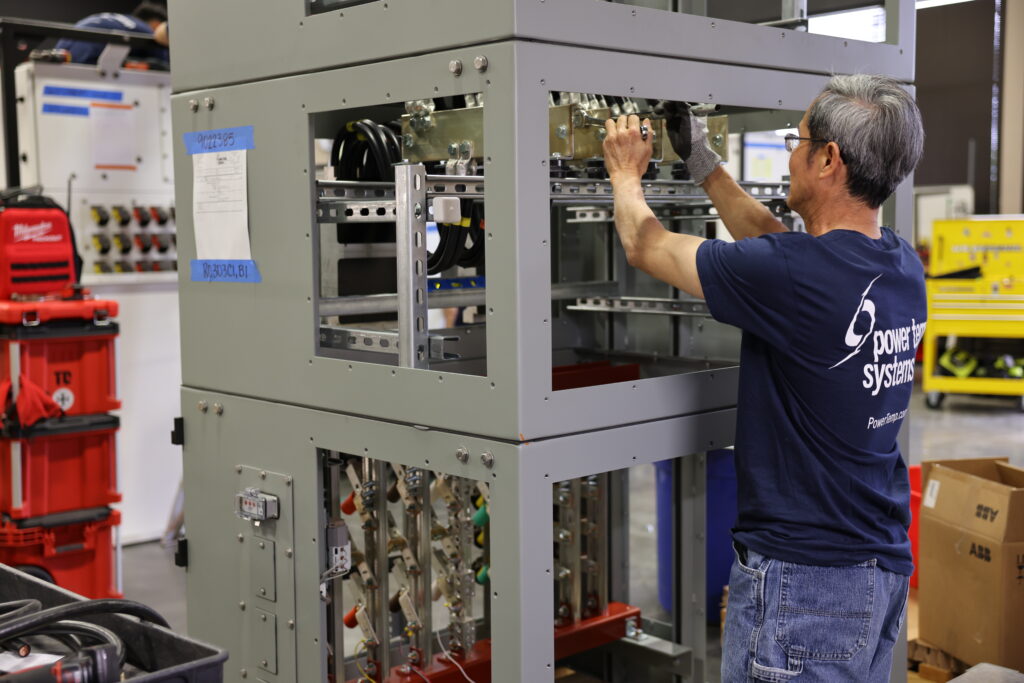
How NFPA 70E Changed On-Site Electrical Work
NFPA 70E sharpened the expectations around how electrical work must be performed in the field, emphasizing:
- Hazard identification
- Training
- Personal protective equipment (PPE)
- Defined procedures
NFPA 70E now functions as the practical framework many organizations use to meet OSHA workplace safety expectations. This means that safer electrical work now operates inside an enforcement environment, rather than a loose set of internal safety preferences.
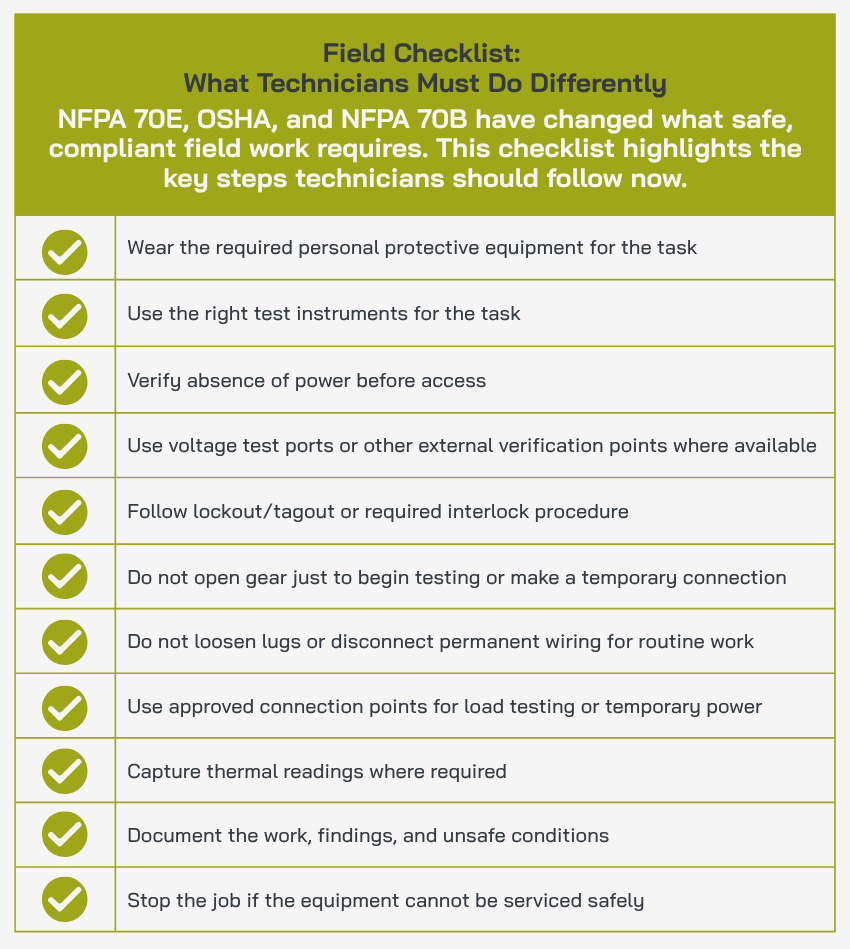
Want the full breakdown of what’s changed and why it matters for your crew?
What Changed in Safer Electrical Work
NFPA 70E made electrical safety procedures more explicit and tied them directly to OSHA-related enforcement and liability.

Hazard Awareness First
Electrical work now starts with identifying and controlling risk before access.

Verification Before Access
Safe conditions cannot be assumed. Absence of voltage must be confirmed.

PPE and Procedure
Personal protective equipment and defined work steps are now part of the requirement.

OSHA Consequences
Failures in procedure can lead to citations, fines, penalties, and added liability.
What Changed in Backup Power Planning
NEC 700.4(F) makes backup continuity during service a planning requirement.

Single Source Offline
If one alternate source must be taken out of service, support still has to be maintained.

Permanent Switching Means
The system must include a defined way to connect a temporary or portable alternate source.
Broader Critical Facilities
These expectations extend beyond hospitals to a wider range of critical operations.

No Improvised Tie-ins
Temporary support cannot depend on workaround-based connection methods.
What Changed in Electrical Testing and Temporary Power Connection
Several standards around electrical testing and temporary power connection now converge.
Rather than being separated, they now jointly shape the same workflow from access and verification through testing, temporary connection, and system readiness.
- NFPA 70E and OSHA-linked safety expectations shape how workers access equipment and verify safe conditions before contact.
- NEC 70, and in critical facility settings, NEC 700.4(F), tighten the requirements around system alteration and temporary connection.
- NFPA 70B reinforces maintenance by requiring repeatable, documented practices that do not degrade the system over time.
- For emergency and standby systems, NFPA 110 adds the expectation that testing and service must support long-term readiness and reliability.
Under the updated code environment, workers must verify safe conditions before contact. Temporary power and load testing require defined connection methods rather than field-built workarounds. Common past practices, such as disconnecting permanent wiring and repeatedly loosening generator or breaker lugs to connect a load bank or portable generator, are no longer code-compliant and could result in fines. Maintenance procedures must be documented, consistent, and non-damaging. Emergency and standby systems also need to remain reliable through service events.
Electrical testing and temporary power connections now have to be supported through controlled access, repeatable connection methods, and maintenance procedures.
How NEC 700.4(F) Changed Backup Power Planning for Critical Facilities
NEC 700.4(F) introduced a requirement that reshaped how critical facilities approach backup power. When an emergency system depends on a single alternate power source, and that source must be taken offline for testing, maintenance, or repair, the system must include permanent switching means to connect a portable or temporary alternative. This requirement makes backup power planning a continuity requirement.
Organizations must also consider which facilities could be affected. Critical operations extend beyond hospitals to a broader set of sites tied to community function, emergency response, and public continuity during outages and disasters. For those facilities, backup power readiness now includes the ability to maintain support while the primary alternate source is being tested or serviced.
“These updated standards now require organizations to maintain equipment on a schedule, follow safer work procedures, avoid altering existing systems for testing, verify safe conditions before access, and maintain backup support where required.”
SECTION III
How Design and Retrofit Decisions Affect NFPA and
NEC Compliance
Design Review Questions to Ask Early
Review these issues before they become maintenance, testing, or continuity problems in the field.
Verify Before Access
Can voltage be verified through a defined method?

Support Safer Inspection
Can thermal inspection be performed without unnecessary exposure?

Test Without Alteration
Can routine testing happen without modifying the permanent system?
Maintain Backup Continuity
Can critical support remain available during service events?
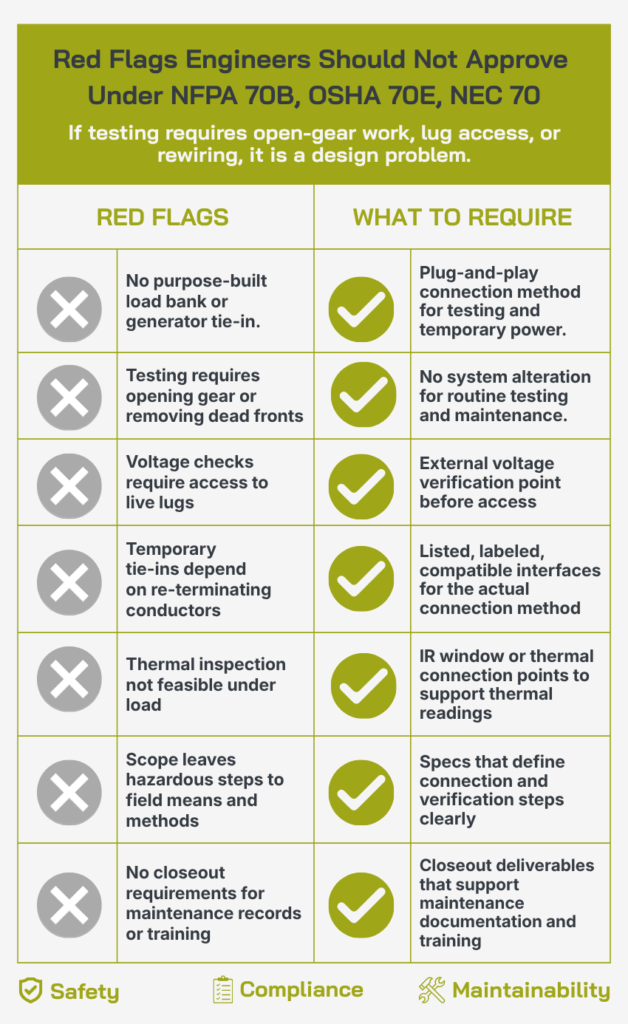
Whether a power system supports compliance with NFPA 70B, NFPA 70E, and the NEC depends heavily on how it was designed, installed, or updated to allow safe access, repeat testing, and long-term serviceability. For new projects, compliance must be considered during design, not after installation. For existing facilities, retrofit planning may be necessary to correct conditions that no longer meet current standards.
Why Compliance Needs to Be Factored In Early
Compliance becomes much harder to achieve when it is treated as something to solve after installation. By that point, access limitations, testing obstacles, and maintenance risks are already built into the system.
That is why compliance has to be considered early in design. Decisions about layout, access, connection methods, switching, and long-term serviceability all affect whether equipment can be maintained and tested within current requirements. If absence-of-voltage verification, thermal inspection, routine testing, or temporary source connection are difficult to perform without unsafe exposure or system alteration, the design is flawed.
What Engineers and Design Teams Should Account For
Engineers and design teams need to consider whether the system will support safe maintenance, testing, and service over time. Access, maintainability, connection methods, switching, and testing workflows determine what technicians and facility teams will be required to do on-site. Needing unsafe exposure, repeated disassembly, or permanent alteration for routine work means the design already failed.
This is especially important for systems that require ongoing testing, thermal inspection, absence-of-voltage verification, or temporary source connection. When safe access, repeatable connection methods, or service continuity are missing from engineering & design, these gaps show up during maintenance, testing, and emergency response.
“Compliance becomes much harder to achieve when it is treated as something to solve after installation.”
How Older Facilities Can Identify and Close Compliance Gaps
Older facilities must recognize that long-standing equipment and established routines do not automatically meet current NFPA 70B, NFPA 70E, and NEC requirements. A system may still be operating, but that does not mean it supports safe access, compliant testing, or well-documented maintenance. For example, an older generator may still operate as expected but lack a dedicated connection point for load-bank testing, forcing technicians to open the equipment and disconnect permanent wiring.
Organizations need to review how equipment is accessed, how testing is performed, whether maintenance procedures are defined, and whether the current setup still depends on unacceptable methods. The review should focus on conditions such as unsafe exposure, permanent system alteration, inconsistent procedures, and incomplete records.
For many dated facilities, that is where retrofit work enters the conversation. Existing systems are being evaluated against how they must be maintained and tested today.
Why Safer Access and Connection Methods Matter
Access and connection methods are not secondary details. They directly affect whether work can be performed in a way that is safe, repeatable, and aligned with current expectations. If the system does not support controlled access and defined connection points, technicians are forced into methods that now create compliance and safety problems.
A system that supports safer access and connection methods is easier to maintain correctly over time. It gives organizations a more reliable way to perform critical work, reduce variation, limit exposure, and support stronger compliance across the life of the equipment.
SECTION IV
System Features That Can Support Compliance
Systems should support safer access, repeatable testing, and controlled temporary power connection. That’s where system features matter. Their role is not to bypass standards, but to help the system support the work in a way that is controlled, repeatable, and aligned with current requirements.
Voltage Test Ports
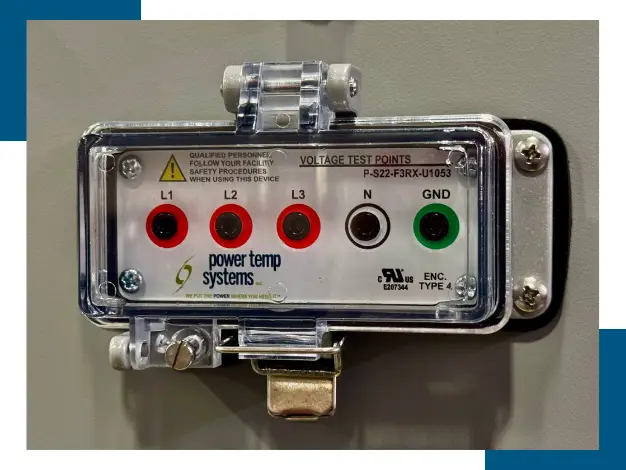
Voltage test ports support one of the most important changes in the updated code environment: safe conditions have to be verified before access. That verification cannot depend on assumptions, quick checks inside the enclosure, or unnecessary exposure to energized components. A voltage test port provides a defined way to confirm electrical status before anyone opens the equipment or begins service work. This is critical for routine maintenance, load testing, temporary power connection, and generator service, where the sequence of the work is crucial.
Used correctly, voltage test ports make absence-of-voltage verification easier to perform through a more consistent process. They also support clearer documentation and reduce the need to turn basic verification into an exposure event.
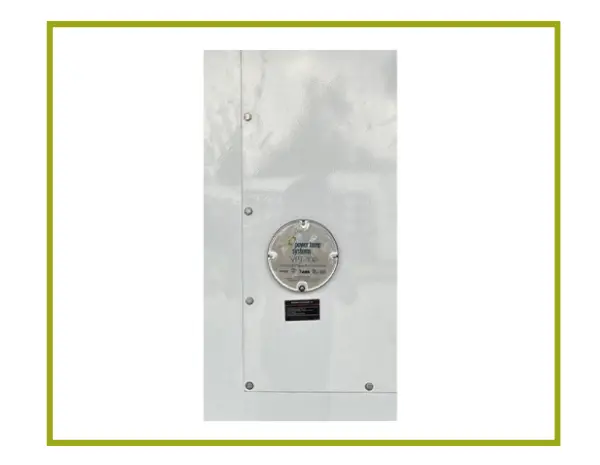
IR Windows
Infrared (IR) windows support another major shift in NFPA 70B maintenance requirements: uthermal inspection under load is now included in the evaluation of equipment condition. Some of the most important warning signs, such as loose connections, rising heat, or developing degradation, only appear when the system is operating under real conditions. This creates an access challenge. If thermal readings require opening equipment or exposing energized parts, the inspection method creates its own safety problem.
IR windows allow technicians to capture readings without opening the enclosure. This supports a more controlled inspection process and facilitates the gathering of thermal data as part of a repeatable maintenance workflow.
Permanent Switching Means and Interlocks
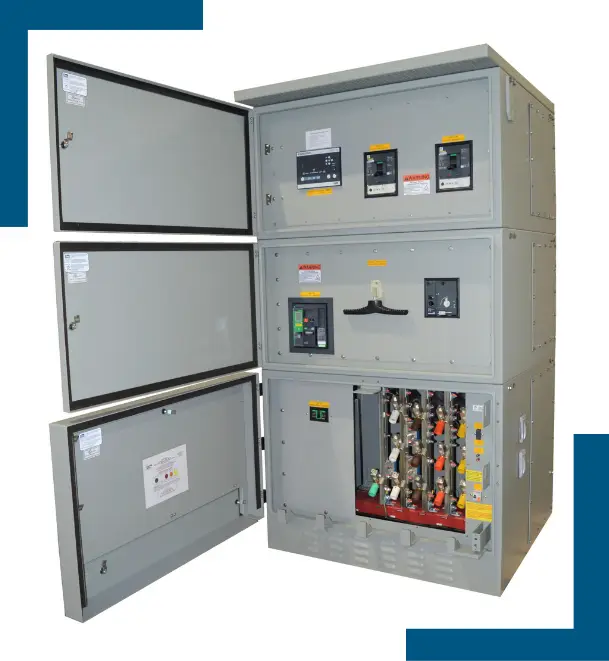
Under NEC 700.4(F), source isolation and temporary power connection can no longer depend on improvised field methods. When maintenance or testing takes a single alternate power source offline, the emergency system must provide permanent switching means for connecting a portable or temporary alternate source.
Permanent switching means and interlocks provide a defined path for isolating sources and managing temporary connection without relying on field modification, open-gear access, or procedures that create unnecessary risk.
Interlocks also help enforce correct sequence. Instead of depending on a technician to manage steps manually, the system itself prevents unsafe switching or connection errors. In a compliance environment that demands more predictable workflows, this level of control matters.
Quick Connect Docking Panels and Safer Temporary Power Connection Methods
Quick connect docking panels and similar connection methods support one of the most practical changes in the updated code environment: temporary power and load testing need a plug-and-play path that does not depend on altering the permanent system. Disconnecting permanent wiring, loosening lugs, and relying on reactive, on-the-spot workarounds in the field result in safety, maintenance, and compliance problems. These methods also degrade the system over time.
Defined connection points allow temporary power and load testing to be carried out through a repeatable method that is built into the system. This is especially important where continuity must be maintained during service events, and where the same equipment will be tested more than once over its life.
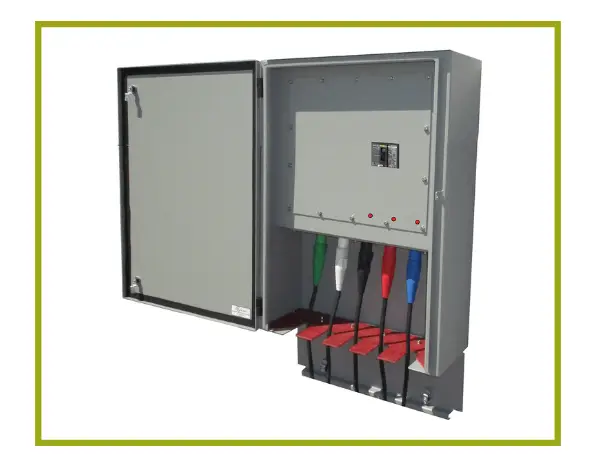
How These System Features Support Safer, More Repeatable Maintenance
These features support safer verification, controlled inspection, defined source isolation, and repeatable temporary power connection. When these features are designed into the system build, the maintenance work becomes easier to plan, repeat, review, and document.
“Defined connection points allow temporary power and load testing to be carried out through a repeatable method that is built into the system.”
This creates a strong foundation for compliance over time. It also helps reduce future risks of unsafe access, degraded connection points, avoidable failures, or continuity problems during service.
SECTION V
What Different Roles Need to Review First
Electrical compliance now encompasses design, maintenance, worker safety, testing, documentation, and backup continuity. This section breaks down priorities by role, so each department can prioritize issues most likely to affect how equipment is accessed, maintained, tested, and supported under updated standards.
For Engineers and Design Teams
Begin by evaluating whether the design supports compliant work throughout the system’s life, beyond its initial performance.
- Access: Can technicians verify safe conditions before access without unnecessary exposure?
- Inspection: Can thermal inspection be performed safely under real operating conditions?
- Testing: Can routine testing be completed without altering the permanent system?
- Connection Methods: Are source isolation and temporary power connection supported through defined methods?
- Continuity: Where required, can backup support be maintained during service events?
For Technicians and Service Teams
Review whether routine work still depends on outdated methods.
- Verification: Is absence of voltage confirmed through a defined process before access?
- Exposure: Does any task still require unnecessary open-gear access or unsafe conditions?
- Testing Methods: Does the work depend on loosening lugs, disconnecting permanent wiring, or building the setup in the field?
- Procedure: Does the job follow a repeatable sequence every time?
- Documentation: Are findings, maintenance steps, and test results recorded clearly?
For Facility Managers and Owners
Determine whether the maintenance and testing process reflects current standards.
- Maintenance Program: Are schedules, procedures, and records clearly defined?
- Qualified Personnel: Is responsibility assigned to trained and qualified people?
- Actual Field Practice: Does the work in the field match the written process?
- Unsafe Dependencies: Does any part of the workflow still rely on unsafe access, system alteration, or repeated disassembly?
- Gap Visibility: Where do current procedures, records, or system features fall short?
For Operators of Emergency and Backup Power Systems
Evaluate whether maintenance and testing can be performed without interrupting required system availability.
- Service Continuity: What happens when the primary alternate source must be taken offline?
- Temporary Source Planning: Is there a defined, code-aligned path to maintain support during service?
- Switching Methods: Do current switching and connection methods support controlled transitions?
- Testing Workflow: Can load testing and related maintenance be performed without workaround-based methods?
- Readiness: Do current procedures protect both reliability and compliance during service events?
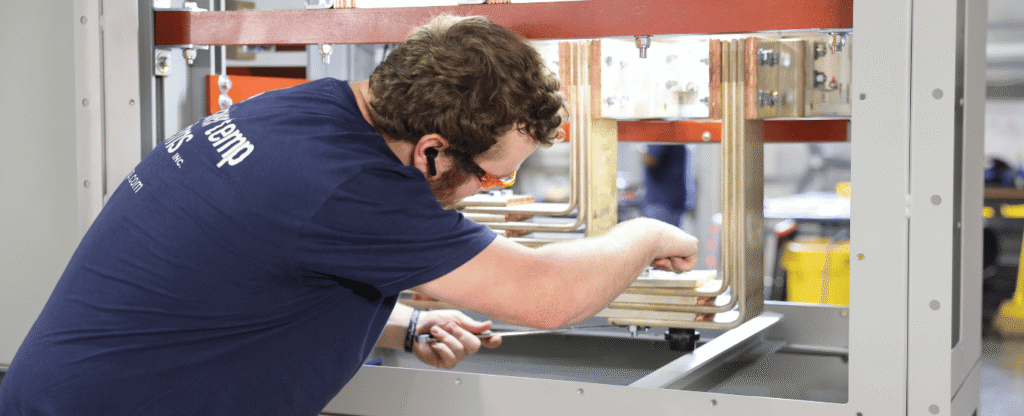
“Compliance now touches every role: design, maintenance, safety, testing, and continuity”
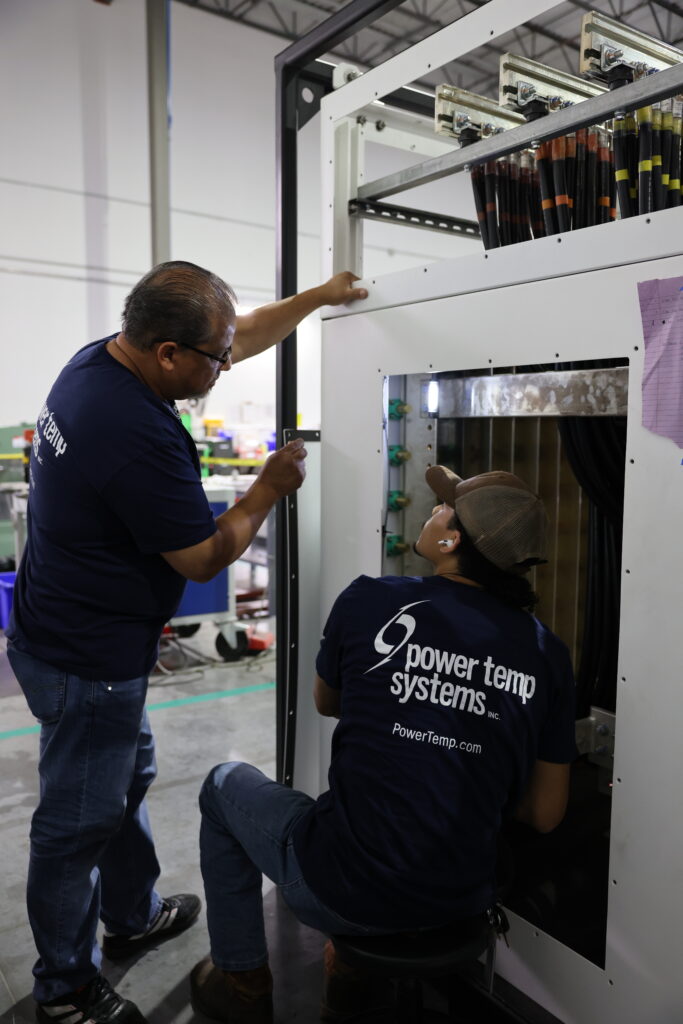

While the operating context may differ by facility type, the core issues remain the same: safe access, defined procedures, controlled testing methods, stronger documentation, and systems that support compliant work over time.
SECTION VI
Common Questions About Electrical Compliance
Electrical compliance can be difficult to interpret due to the multiple standards working in conjunction. For many organizations, the challenge is understanding how those requirements apply to real maintenance, testing, and backup power planning. This section addresses several of the questions that come up most often, including existing facilities, system alteration during testing, critical facility planning, and the relationship between maintenance and backup power standards.
Electrical testing and maintenance expectations carry significantly more structure and accountability. Work that once relied on familiarity, judgment in the moment, or informal routines is now expected to follow defined procedures that support safer access, repeatable testing, and clearer records.
These updates are the result of the NFPA 70B, NFPA 70E, the NEC, and OSHA-related enforcements. NFPA 70B drives more explicit maintenance requirements. NFPA 70E raises the standard for safe work practices, PPE, and verification before access. The NEC reinforces that testing should not depend on altering the permanent system, and NEC 700.3(F) makes that point especially clear in emergency power settings.
Current expectations require that maintenance and testing be performed through methods that are safer, repeatable, and able to withstand review, inspection, and liability scrutiny.
Yes. Current expectations extend into how equipment is accessed, maintained, tested, and documented over time, including in facilities with long-standing systems already in service.
This is where many organizations uncover gaps. Equipment may still be operating as intended, but the surrounding maintenance and testing methods may no longer align with current safety and compliance requirements. Long-standing practices do not remain acceptable simply because the system has been in place for years.
NEC 700.4(F) applies when an emergency system depends on a single alternate power source and that source must be taken offline for testing, maintenance, or repair. In that situation, the code requires permanent switching means to connect a portable or temporary alternate source so emergency support can be maintained.
Continuity can no longer depend on a field-built connection method or a last-minute workaround. The system has to support the transition through a defined, code-aligned method that is already built in. This requirement matters most where emergency support cannot be interrupted during routine service, testing, or repair.
NFPA 70B and NFPA 110 address different parts of the compliance picture. NFPA 70B focuses broadly on electrical equipment maintenance, including how maintenance programs should be structured, documented, and carried out across electrical systems.
NFPA 110 is narrower and more application-specific. It focuses on emergency and standby power systems, with an emphasis on readiness, reliability, and performance when normal power is lost.
Under NEC 700.4(F), connecting a portable or temporary alternate source cannot depend on modifying the permanent system wiring. In practice, the work cannot require disconnecting permanent wiring, loosening lugs, or building a temporary connection setup in the field in order to complete testing, maintenance, or temporary power connection.
If the only way to perform the work is to alter the permanent system, the setup does not meet the requirement. The expectation is that the system already supports the connection or testing method through a defined, repeatable, and safer process built into the equipment and installation.
NEC 700.4(F) applies when an emergency system depends on a single alternate power source that must be taken offline during testing, maintenance, or repair. That requirement has widened the practical conversation around which facilities must remain supported during service activities.
By definition, a critical facility is tied to life safety, public safety, emergency response, or essential community function. Many municipal and community-sustaining operations meet this definition, since the loss of backup power during an outage can no longer be treated as a minor inconvenience.
Organizations should review current practices for accessing, maintaining, testing, and documenting equipment, flagging any that still rely on system alteration, unsafe exposure, or inconsistent methods. This review should focus on real operating conditions.
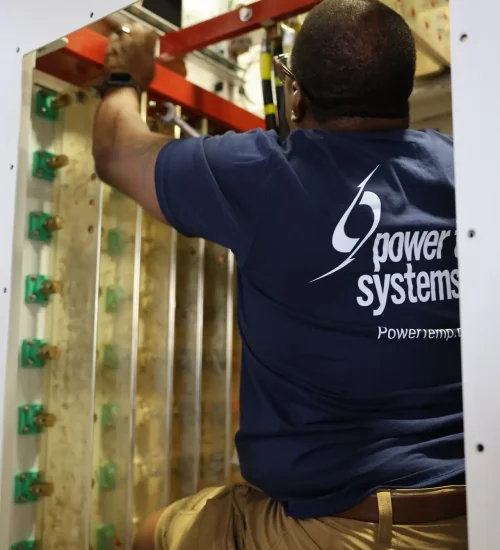
“NEC 700.4(F) applies when an emergency system depends on a single alternate power source and that source must be taken offline for testing, maintenance, or repair.”
SECTION VII
Turning Compliance
Awareness Into Action
The final step is identifying where current maintenance, testing, access, and backup power practices no longer meet today’s requirements. The goal is to turn awareness into a practical review of risks and ruthless prioritization of safety, compliance, and system reliability.
HOW TO START IDENTIFYING COMPLIANCE GAPS
How is work performed around the equipment today? Consider access methods, testing procedures, maintenance schedules, documentation practices, and any activity that still depends on unsafe exposure, permanent system alteration, or inconsistent field execution.
A strong starting point is to identify where current workflows no longer support code-aligned work, and prioritizing these gaps by urgency, operational impact, and the level of risk they create.
WHAT SHOULD ORGANIZATIONS PRIORITIZE FIRST FOR ELECTRICAL COMPLIANCE?
Any condition that creates immediate safety or compliance exposure should be prioritized. This includes:
Unsafe access
Missing Verification Steps
Undefined testing methods
Permanent system alteration
Any situation where backup continuity cannot be maintained when required
After that, attention should turn to repeatability and control. Maintenance and testing procedures should be clear, consistent, and supported by documentation that shows how the work is performed, reviewed, and tracked over time. Organizations can then address larger structural issues, including retrofit needs, connection methods, inspection access, and backup power planning.
WHEN DOES IT MAKE SENSE TO TALK TO AN ELECTRICAL SAFETY AND COMPLIANCE EXPERT?
Expert guidance becomes especially valuable when an organization is unsure whether its current equipment setup, maintenance procedures, testing methods, or backup power planning meet today’s expectations. Power Temp Systems can help organizations identify where those gaps exist and evaluate safer, more compliant paths forward. Talk with our team to start the conversation.
ABOUT POWER TEMP SYSTEMS
Power Temp Systems is a leading US manufacturer of permanent and portable power distribution systems. Through high-quality
engineering, we deliver customized and standard solutions that increase our customers’ operational efficiency.
IMPORTANT NOTE
This guide is intended for educational purposes only. It should not be treated as legal advice, an official code interpretation, or a substitute for project-specific engineering review.
LAST UPDATED: October 2026
STANDARDS REFERENCED
NFPA 70, NFPA 70B, NFPA 70E, NFPA 110, NEC 700.4(F), and related OSHA workplace safety expectations.