CASE STUDY OVERVIEW
When a major U.S. big-box retailer’s facilities team began planning routine generator maintenance at one of its distribution centers, what started as a standard upgrade quickly revealed a deeper issue: the safety and compliance risk associated with existing backup power connections.
As a leader in retail with over 50 distribution facilities across the United States, the organization runs round-the-clock operations. Any vulnerability in critical power systems can translate directly into loss of inventory, inability to process purchasing transactions, inefficiencies in logistics communications and more.
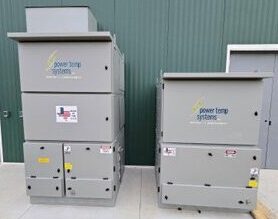
Because of these vulnerabilities, they depend on reliable backup power to keep operations moving during outages. When the team realized that their generator setups lacked a standardized, code-compliant means of safe load testing and source switching, they turned to Power Temp Systems (PTS) for a solution that could do more than meet electrical code. It had to protect inventory and operations.
PROJECT SCOPE
Backup generators are the backbone of resilient facilities, especially for critical distribution hubs. These sites rely on uninterrupted power to support sorting, logistics, and dispatching operations that feed stores nationwide. But many of the older setups across distribution centers did not include a safe, repeatable method for disconnecting utility power and engaging generators during tests.

National Electrical Code (NEC) guidelines, including NEC 700.3(F), require safe mechanisms for load testing and transfer of power sources. Without a clearly defined safety mechanism, technicians faced the risk of inadvertent simultaneous connection of two power sources, a scenario that can cause electrical arcs, equipment damage, or serious injury.
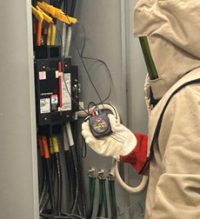
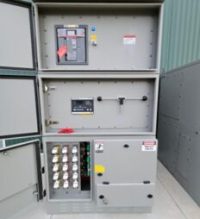
The client had to replace an existing generator at a distribution center in Topeka, KS, after which they did not have the ability to add portable power once they replaced it. As a result, they needed a docking station to gain compliance. Once they learned the Topeka site was out of compliance, they realized most of their 50+ of their distribution centers nationwide had the same condition.
Across the distributed fleet of facilities, the major U.S. retailer’s team found variations in how generator power was tied into building systems. For an organization where operational continuity is core to the business model, this variation presented a large scale risk.
INTEGRATED SOLUTION
The existing relationship with Power Temp Systems provided awareness to a trusted solution partner, and they felt confident in Power Temp Systems’ ability to get them into compliance quickly. A major priority for our client was adopting a docking solution that was easy to install and operate, without needing specialized installer and operator training or expertise.
Recognizing both the operational and safety implications, the major U.S. retailer engaged Power Temp Systems (PTS) to design and implement a solution that went beyond compliance. While many code-compliant options exist on paper, PTS focused on safety-by-design – an approach that inherently minimizes the possibility of human error.
PTS recommended and supplied seven different options for the client to consider and recommended the best-fit solution within that set. The major U.S. retailer first considered wall-mount quick-connect and single-use rotary approaches for portable generator connections. The PTS team pointed out, however, that the single-purpose rotary dock did not allow load testing, which would not deliver compliance with the NEC code. As a result, the client selected a dual-purpose rotary docking station for every participating distribution center.
Dual-purpose docking stations have male and female cam-loks; the female connections are used for permanent generator load bank testing, and the male fittings bring power into the building.
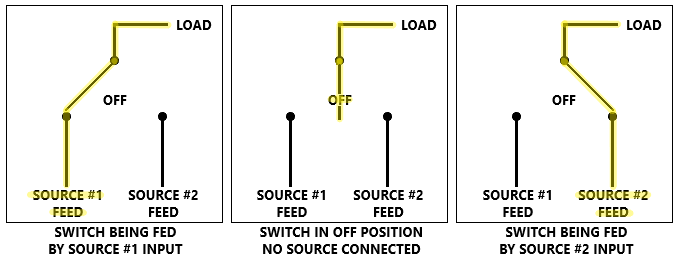
These docking stations serve two functions in one unit:
Safe Load Testing
A secure, dedicated connection point for generators to simulate load conditions without exposing personnel to unsafe electrical transfer scenarios.
Reliable Power Docking
A clear, lockable mechanism for connecting and disconnecting backup generators during outages or maintenance.
What sets this approach apart is how it simplifies a traditionally complex and risky process. Rather than relying on procedural safeguards or manual cable disconnects for load testing, each rotary station provides a clear, mechanical step that inherently enforces safety. This approach also mitigates any variation of installer and operator skill.
In the end, operational safety wasn’t an afterthought; it was built into the way the system works.
ROLLING OUT SAFETY AT SCALE
Designing a solution was only half the challenge. The client’s distribution network spans dozens of facilities, each with unique power configurations and load requirements. PTS helped the major U.S. retailer plan the rollout with careful attention to these site-specific details, partnering with Gunthrett as the manufacturer’s representative and ProKey as the electrical contractor. The process the team applied was:
Assessment: PTS evaluated generator, electrical distribution, and load-testing requirements at each location.
Customization: Stations were configured to match local amperage and infrastructure needs.
Coordination: Install schedules were aligned with maintenance windows to avoid operational disruptions.
The deployment spanned around 47 distribution centers nationwide, creating a consistent and reliable power safety standard across the client’s operations. Technicians at each facility were trained on the operation of the new equipment, emphasizing a unified approach to safety and compliance.
This consistency was critical; not just for compliance, but for operations. No matter where a technician works, the system behaves the same way and the steps for safe testing are clear and repeatable.
Through the project, the team determined that some distribution centers needed different amperage levels, leading to a safer, more effective end state after docking station installation. This type of expertise is inherent with the partnership with PTS.
THE OUTCOMES
The impact of the project can be seen in several areas that matter most to facility operations and risk management:
Safer Operations: By replacing varied and potentially risky setups with standardized rotary docking stations, the client significantly reduced the chances of unsafe connections during load testing or transfers. The clarity of the system’s design limits ambiguity for technicians and reinforces safe practices.
Code Compliance Made Practical: For the major U.S. retailer, meeting NEC requirements no longer feels like a checkbox; it is part of daily operations. Facilities now have reliable methods embedded into their infrastructure that align with both code and practical usage. And non-compliance has a cost: the communication managed by PTS and Gunthrett delivered an outcome that avoided non-compliance fines on the order of hundreds of thousands of dollars.
Reduced Exposure During Inspections: With a standardized solution across dozens of sites, audits and inspections become smoother. Compliance risk is lowered because the infrastructure itself conforms to recognized safety standards.
Operational Resilience: If the distribution center loses power, the business risk in lost revenue can reach a million dollars – or more. Now with clear, repeatable procedures, distribution centers can manage generator testing, maintenance, and outages with greater confidence with less risk of human error disrupting operations.
CLOSING: A SAFER PATH FORWARD
What began as a routine generator upgrade became an opportunity for the client to elevate its safety posture in a meaningful and measurable way. By partnering with PTS, this major U.S. big-box retailer transformed a compliance-driven need into a safer, more resilient standard of power system operation across its nationwide distribution network.
The successful diagnosis and installation PTS delivered of its dual-purpose rotary docking stations has led to expanding the relationship to consider other applications.
Safety, as it turns out, is something that can be built into the way you work.